(Excerpts taken from The Dolorous Passion of our Lord Jesus Christ by Blessed Anne Catherine Emmerich, Mystic, Stigmatist, Visionary, and Prophet)
The last accusation—that of Jesus causing himself to be called king—made some impression upon Pilate; he became a little thoughtful, left the terrace and, casting a scrutinising glance on Jesus, went into the adjoining apartment, and ordered the guards to bring him alone into his presence. Pilate was not only superstitious, but likewise extremely weak-minded and susceptible. He had often, during the course of his pagan education, heard mention made of sons of his gods who had dwelt for a time upon earth; he was likewise fully aware that the Jewish prophets had long foretold that one should appear in the midst of them who should be the Anointed of the Lord, their Saviour, and Deliverer from slavery; and that many among the people believed this firmly. He remembered likewise that kings from the east had come to Herod, the predecessor of the present monarch of that name, to pay homage to a newly-born king of the Jews, and that Herod had on this account given orders for the massacre of the Innocents. He had often heard of the traditions concerning the Messiah and the king of the Jews, and even examined them with some curiosity; although of course, being a pagan, without the slightest belief. Had he believed at all, he would probably have agreed with the Herodians, and with those Jews who expected a powerful and victorious king. With such impressions, the idea of the Jews accusing the poor miserable individual whom they had brought into his presence of setting himself up as the promised king and Messiah, of course appeared to him absurd; but as the enemies of Jesus brought forward these charges in proof of treason against the emperor, he thought it proper to interrogate him privately concerning them.
‘Art thou the king of the Jews?’ said Pilate, looking at our Lord, and unable to repress his astonishment at the divine expression of his countenance.
Jesus made answer, ‘Sayest thou this thing of thyself, or have others told it thee of me?’
Pilate was offended that Jesus should think it possible for him to believe such a thing, and answered, ‘Am I a Jew? Thy own nation and the chief priests have delivered thee up to me as deserving of death: what hast thou done?’
Jesus answered majestically, ‘My kingdom is not of this world. If my kingdom were of this world, my servants would certainly strive that I should not be delivered to the Jews; but now my kingdom is not from hence.’
Pilate was somewhat moved by these solemn words, and said to him in a more serious tone, ‘Art thou a king, then?’
Jesus answered, ‘Thou sayest that I am a king. For this was I born, and for this I came into the world, that I should give testimony to the truth. Every one that is of the truth heareth my voice.’
-oOo-
The Scourging of Jesus
The night had been extremely cold, and the morning was dark and cloudy; a little hail had fallen, which surprised every one, but towards twelve o’clock the day became brighter, and the sun shone forth.
The two fresh executioners commenced scourging Jesus with the greatest possible fury; they made use of a different kind of rod,—a species of thorny stick, covered with knots and splinters. The blows from these sticks tore his flesh to pieces; his blood spouted out so as to stain their arms, and he groaned, prayed, and shuddered. At this moment, some strangers mounted on camels passed through the forum; they stopped for a moment, and were quite overcome with pity and horror at the scene before them, upon which some of the bystanders explained the cause of what they witnessed. Some of these travellers had been baptised by John, and others had heard the sermon of Jesus on the mountain. The noise and the tumult of the mob was even more deafening near the house of Pilate.
Two fresh executioners took the places of the last mentioned, who were beginning to flag; their scourges were composed of small chains, or straps covered with iron hooks, which penetrated to the bone, and tore off large pieces of flesh at every blow. What word, alas! could describe this terrible—this heartrending scene!
The cruelty of these barbarians was nevertheless not yet satiated; they untied Jesus, and again fastened him up with his back turned towards the pillar. As he was totally unable to support himself in an upright position, they passed cords round his waist, under his arms, and above his knees, and having bound his hands tightly into the rings which were placed at the upper part of the pillar, they recommenced scourging him with even greater fury than before; and one among them struck him constantly on the face with a new rod. The body of our Lord was perfectly torn to shreds,—it was but one wound. He looked at his torturers with his eyes filled with blood, as if entreating mercy; but their brutality appeared to increase, and his moans each moment became more feeble.
When Jesus fell down at the foot of the pillar, after the flagellation, I saw Claudia Procles, the wife of Pilate, send some large pieces of linen to the Mother of God. I know not whether she thought that Jesus would be set free, and that his Mother would then require linen to dress his wounds, or whether this compassionate lady was aware of the use which would be made of her present. At the termination of the scourging, Mary came to herself for a time, and saw her Divine Son all torn and mangled, being led away by the archers after the scourging: he wiped his eyes, which were filled with blood, that he might look at his Mother, and she stretched out her hands towards him, and continued to look at the bloody traces of his footsteps. I soon after saw Mary and Magdalen approach the pillar where Jesus had been scourged; the mob were at a distance, and they were partly concealed by the other holy women, and by a few kind-hearted persons who had joined them; they knelt down on the ground near the pillar, and wiped up the sacred blood with the linen which Claudia Procles had sent. John was not at that time with the holy women, who were about twenty in number. The sons of Simeon and of Obed, and Veronica, as also the two nephews of Joseph of Arimathea—Aram and Themni—were in the Temple, and appeared to be overwhelmed with grief. It was not more than nine o’clock A.M. when the scourging terminated.
-oOo-
The Crowning with Thorns
In the middle of the court there stood the fragment of a pillar, and on it was placed a very low stool which these cruel men maliciously covered with sharp flints and bits of broken potsherds. Then they tore off the garments of Jesus, thereby reopening all his wounds; threw over his shoulders an old scarlet mantle which barely reached his knees; dragged him to the seat prepared, and pushed him roughly down upon it, having first placed the crown of thorns upon his head. The crown of thorns was made of three branches plaited together, the greatest part of the thorns being purposely turned inwards so as to pierce our Lord’s head. Having first placed these twisted branches on his forehead, they tied them tightly together at the back of his head, and no sooner was this accomplished to their satisfaction than they put a large reed into his hand, doing all with derisive gravity as if they were really crowning him king. They then seized the reed, and struck his head so violently that his eyes were filled with blood; they knelt before him, derided him, spat in his face, and buffeted him, saying at the same time, ‘Hail, King of the Jews!’ Then they threw down his stool, pulled him up again from the ground on which he had fallen, and reseated him with the greatest possible brutality.
It is quite impossible to describe the cruel outrages which were thought of and perpetrated by these monsters under human form. The sufferings of Jesus from thirst, caused by the fever which his wounds and sufferings had brought on, were intense.* He trembled all over, his flesh was torn piecemeal, his tongue contracted, and the only refreshment he received was the blood which trickled from his head on to his parched lips. This shameful scene was protracted a full half-hour, and the Roman soldiers continued during the whole time to applaud and encourage the perpetration of still greater outrages.
-oOo-
Jesus Condemned to be Crucified
The Blessed Virgin, who had retired to some distance after the scourging of Jesus, again approached to hear the sentence of death pronounced upon her Son and her God. Jesus stood in the midst of the archers, at the foot of the staircase leading up to the tribunal. The trumpet was sounded to demand silence, and then the cowardly, the base judge, in a tremulous undecided voice, pronounced the sentence of death on the Just Man. The sight of the cowardice and duplicity of this despicable being, who was nevertheless puffed up with pride at his important position, almost overcame me, and the ferocious joy of the executioners—the triumphant countenances of the High Priests, added to the deplorable condition to which our loving Saviour was reduced, and the agonising grief of his beloved Mother—still further increased my pain. I looked up again, and saw the cruel Jews almost devouring their victim with their eyes, the soldiers standing coldly by, and multitudes of horrible demons passing to and fro and mixing in the crowd. I felt that I ought to have been in the place of Jesus, my beloved Spouse, for the sentence would not then have been unjust; but I was so overcome with anguish, and my sufferings were so intense, that I cannot exactly remember all that I did see. However, I will relate all as nearly as I can.
After a long preamble, which was composed principally of the most pompous and exaggerated eulogy of the Emperor Tiberias, Pilate spoke of the accusations which had been brought against Jesus by the High Priests. He said that they had condemned him to death for having disturbed the public peace, and broken their laws by calling himself the Son of God and King of the Jews; and that the people had unanimously demanded that their decree should be carried out. Notwithstanding his oft repeated conviction of the innocence of Jesus, this mean and worthless judge was not ashamed of saying that he likewise considered their decision a just one, and that he should therefore pronounce sentence—which he did in these words: ‘I condemn Jesus of Nazareth, the King of the Jews, to be crucified ;’ and he ordered the executioners to bring the cross. I think I remember likewise that he took a long stick in his hands, broke it, and threw the fragments at the feet of Jesus.
The Blessed Virgin, who had retired to some distance after the scourging of Jesus, again approached to hear the sentence of death pronounced upon her Son and her God. Jesus stood in the midst of the archers, at the foot of the staircase leading up to the tribunal. The trumpet was sounded to demand silence, and then the cowardly, the base judge, in a tremulous undecided voice, pronounced the sentence of death on the Just Man. The sight of the cowardice and duplicity of this despicable being, who was nevertheless puffed up with pride at his important position, almost overcame me, and the ferocious joy of the executioners—the triumphant countenances of the High Priests, added to the deplorable condition to which our loving Saviour was reduced, and the agonising grief of his beloved Mother—still further increased my pain. I looked up again, and saw the cruel Jews almost devouring their victim with their eyes, the soldiers standing coldly by, and multitudes of horrible demons passing to and fro and mixing in the crowd. I felt that I ought to have been in the place of Jesus, my beloved Spouse, for the sentence would not then have been unjust; but I was so overcome with anguish, and my sufferings were so intense, that I cannot exactly remember all that I did see. However, I will relate all as nearly as I can.
After a long preamble, which was composed principally of the most pompous and exaggerated eulogy of the Emperor Tiberias, Pilate spoke of the accusations which had been brought against Jesus by the High Priests. He said that they had condemned him to death for having disturbed the public peace, and broken their laws by calling himself the Son of God and King of the Jews; and that the people had unanimously demanded that their decree should be carried out. Notwithstanding his oft repeated conviction of the innocence of Jesus, this mean and worthless judge was not ashamed of saying that he likewise considered their decision a just one, and that he should therefore pronounce sentence—which he did in these words: ‘I condemn Jesus of Nazareth, the King of the Jews, to be crucified ;’ and he ordered the executioners to bring the cross. I think I remember likewise that he took a long stick in his hands, broke it, and threw the fragments at the feet of Jesus.
On hearing these words of Pilate the Mother of Jesus became for a few moments totally unconscious, for she was now certain that her beloved Son must die the most ignominious and the most painful of all deaths. John and the holy women carried her away, to prevent the heartless beings who surrounded them from adding crime to crime by jeering at her grief; but no sooner did she revive a little than she begged to be taken again to each spot which had been sanctified by the sufferings of her Son, in order to bedew them with her tears; and thus did the Mother of our Lord, in the name of the Church, take possession of those holy places.
-oOo-
The Carrying of the Cross
By means of ropes, which the executioners had fastened to the foot of the cross, two archers supported it to prevent its getting entangled in anything, and four other soldiers took hold of the ropes, which they had fastened to Jesus underneath his clothes. The sight of our dear Lord trembling beneath his burden, reminded me forcibly of Isaac, when he carried the wood destined for his own sacrifice up the mountain. The trumpet of Pilate was sounded as the signal for departure, for he himself intended to go to Calvary at the head of a detachment of soldiers, to prevent the possibility of an insurrection. He was on horseback, in armour, surrounded by officers and a body of cavalry, and followed by about three hundred of the infantry, who came from the frontiers of Italy and Switzerland. The procession was headed by a trumpeter, who sounded his trumpet at every corner and proclaimed the sentence. A number of women and children walked behind the procession with ropes, nails, wedges, and baskets filled with different articles, in their hands; others, who were stronger, carried poles, ladders, and the centre pieces of the crosses of the two thieves, and some of the Pharisees followed on horseback. A boy who had charge of the inscription which Pilate had written for the cross, likewise carried the crown of thorns (which had been taken off the head of Jesus) at the end of a long stick, but he did not appear to be wicked and hard-hearted like the rest.
Next I beheld our Blessed Saviour and Redeemer—his bare feet swollen and bleeding—his back bent as though he were about to sink under the heavy weight of the cross, and his whole body covered with wounds and blood. He appeared to be half fainting from exhaustion (having had neither refreshment nor sleep since the supper of the previous night), weak from loss of blood, and parched with thirst produced by fever and pain. He supported the cross on his right shoulder with his right hand, the left hung almost powerless at his side, but he endeavoured now and then to hold up his long garment to prevent his bleeding feet from getting entangled in it. The four archers who held the cords which were fastened round his waist, walked at some distance from him, the two in front pulled him on, and the two behind dragged him back, so that he could not get on at all without the greatest difficulty. His hands were cut by the cords with which they had been bound; his face bloody and disfigured; his hair and beard saturated with blood; the weight of the cross and of his chains combined to press and make the woollen dress cleave to his wounds, and reopen them: derisive and heartless words alone were addressed to him, but he continued to pray for his persecutors, and his countenance bore an expression of combined love and resignation.
Many soldiers under arms walked by the side of the procession, and after Jesus came the two thieves, who were likewise led, the arms of their crosses, separate from the middle, being placed upon their backs, and their hands tied tightly to the two ends. They were clothed in large aprons, with a sort of sleeveless scapular which covered the upper part of their bodies, and they had straw caps upon their heads. The good thief was calm, but the other was, on the contrary, furious, and never ceased cursing and swearing. The rear of the procession was brought up by the remainder of the Pharisees on horseback, who rode to and fro to keep order. Pilate and his courtiers were at a certain distance behind; he was in the midst of his officers clad in armour, preceded by a squadron of cavalry, and followed by three hundred foot soldiers; he crossed the forum, and then entered one of the principal streets, for he was marching through the town in order to prevent any insurrection among the people.
-oOo-
Simon of Cyrene
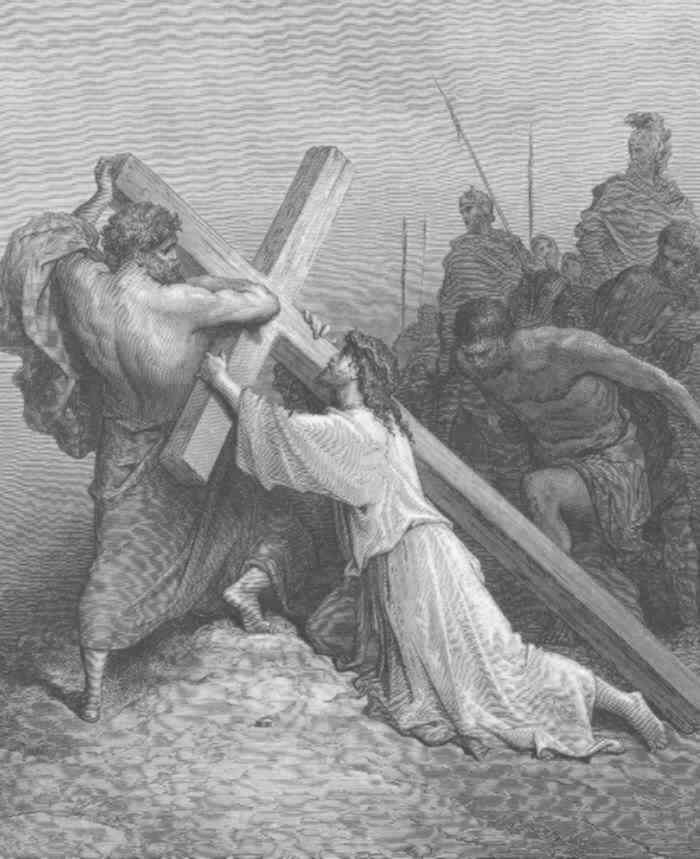
The procession had reached an arch formed in an old wall belonging to the town, opposite to a square, in which three streets terminated, when Jesus stumbled against a large stone which was placed in the middle of the archway, the cross slipped from his shoulder, he fell upon the stone, and was totally unable to rise. Many respectable looking persons who were on their way to the Temple stopped, and exclaimed compassionately: ‘Look at that poor man, he is certainly dying!’ but his enemies showed no compassion. This fall caused a fresh delay, as our Lord could not stand up again, and the Pharisees said to the soldiers: ‘We shall never get him to the place of execution alive, if you do not find some one to carry his cross.’ At this moment Simon of Cyrene, a pagan, happened to pass by, accompanied by his three children. He was a gardener, just returning home after working in a garden near the eastern wall of the city, and carrying a bundle of lopped branches. The soldiers perceiving by his dress that he was a pagan, seized him, and ordered him to assist Jesus in carrying his cross. He refused at first, but was soon compelled to obey, although his children, being frightened, cried and made a great noise, upon which some women quieted and took charge of them. Simon was much annoyed, and expressed the greatest vexation at being obliged to walk with a man in so deplorable a condition of dirt and misery; but Jesus wept, and cast such a mild and heavenly look upon him that he was touched, and instead of continuing to show reluctance, helped him to rise, while the executioners fastened one arm of the cross on his shoulders, and he walked behind our Lord, thus relieving him in a great measure from its weight; and when all was arranged, the procession moved forward. Simon was a stout-looking man, apparently about forty years of age. His children were dressed in tunics made of a variegated material; the two eldest, named Rufus and Alexander, afterwards joined the disciples; the third was much younger, but a few years later went to live with St. Stephen. Simon had not carried the cross after Jesus any length of time before he felt his heart deeply touched by grace.
-oOo-
The Veil of Veronica
While the procession was passing through a long street, an incident took place which made a strong impression upon Simon. Numbers of respectable persons were hurrying towards the Temple, of whom many got out of the way when they saw Jesus, from a Pharisaical fear of defilement, while others, on the contrary, stopped and expressed pity for his sufferings. But when the procession had advanced about two hundred steps from the spot where Simon began to assist our Lord in carrying his cross, the door of a beautiful house on the left opened, and a woman of majestic appearance, holding a young girl by the hand, came out, and walked up to the very head of the procession. Seraphia was the name of the brave woman who thus dared to confront the enraged multitude; she was the wife of Sirach, one of the councillors belonging to the Temple, and was afterwards known by the name of Veronica, which name was given from the words vera icon (true portrait), to commemorate her brave conduct on this day.
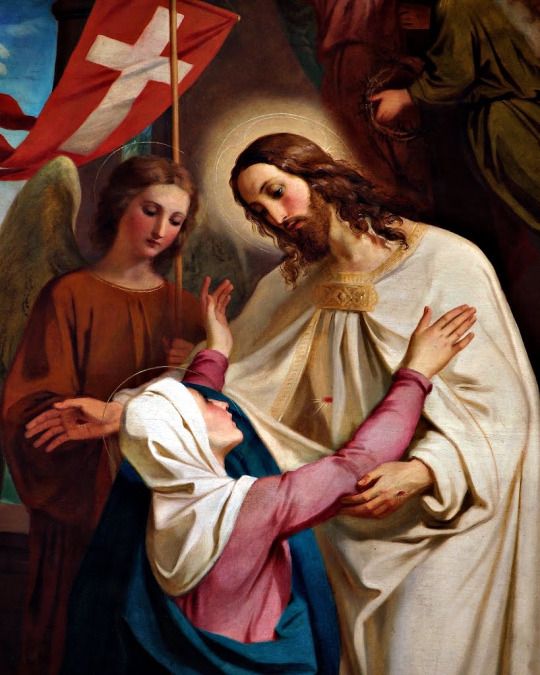
Seraphia had prepared some excellent aromatic wine, which she piously intended to present to our Lord to refresh him on his dolorous way to Calvary. She had been standing in the street for some time, and at last went back into the house to wait. She was, when I first saw her, enveloped in a long veil, and holding a little girl of nine years of age whom she had adopted, by the hand; a large veil was likewise hanging on her arm, and the little girl endeavoured to hide the jar of wine when the procession approached. Those who were marching at the head of the procession tried to push her back; but she made her way through the mob, the soldiers, and the archers, reached Jesus, fell on her knees before him, and presented the veil, saying at the same time, ‘Permit me to wipe the face of my Lord.’ Jesus took the veil in his left hand, wiped his bleeding face, and returned it with thanks. Seraphia kissed it, and put it under her cloak. The girl then timidly offered the wine, but the brutal soldiers would not allow Jesus to drink it. The suddenness of this courageous act of Seraphia had surprised the guards, and caused a momentary although unintentional halt, of which she had taken advantage to present the veil to her Divine Master. Both the Pharisees and the guards were greatly exasperated, not only by the sudden halt, but much more by the public testimony of veneration which was thus paid to Jesus, and they revenged themselves by striking and abusing him, while Seraphia returned in haste to her house.
No sooner did she reach her room than she placed the woollen veil on a table, and fell almost senseless on her knees. A friend who entered the room a short time after, found her thus kneeling, with the child weeping by her side, and saw, to his astonishment, the bloody countenance of our Lord imprinted upon the veil, a perfect likeness, although heartrending and painful to look upon. He roused Seraphia, and pointed to the veil. She again knelt down before it, and exclaimed through her tears, ‘Now I shall indeed leave all with a happy heart, for my Lord has given me a remembrance of himself.’ The texture of this veil was a species of very fine wool; it was three times the length of its width, and was generally worn on the shoulders. It was customary to present these veils to persons who were in affliction, or over-fatigued, or ill, that they might wipe their faces with them, and it was done in order to express sympathy or compassion. Veronica kept this veil until her death, and hung it at the head of her bed; it was then given to the Blessed Virgin, who left it to the Apostles, and they afterwards passed it on to the Church.
-oOo-
Jesus on Mount Golgotha
The procession again moved on; the road was very steep and rough between the walls of the town and Calvary, and Jesus had the greatest difficulty in walking with his heavy burden on his shoulders; but his cruel enemies, far from feeling the slightest compassion, or giving the least assistance, continued to urge him on by the infliction of hard blows, and the utterance of dreadful curses. At last they reached a spot where the pathway turned suddenly to the south; here he stumbled and fell for the sixth time. The fall was a dreadful one, but the guards only struck him the harder to force him to get up, and no sooner did he reach Calvary than he sank down again for the seventh time.
Simon of Cyrene was filled with indignation and pity; notwithstanding his fatigue, he wished to remain that he might assist Jesus, but the archers first reviled, and then drove him away, and he soon after joined the body of disciples. The executioners then ordered the workmen and the boys who had carried the instruments for the execution to depart, and the Pharisees soon arrived, for they were on horseback, and had taken the smooth and easy road which ran to the east of Calvary. There was a fine view of the whole town of Jerusalem from the top of Calvary. This top was circular, and about the size of an ordinary riding-school, surrounded by a low wall, and with five separate entrances. This appeared to be the usual number in those parts, for there were five roads at the baths, at the place where they baptised, at the pool of Bethsaida, and there were likewise many towns with five gates. In this, as in many other peculiarities of the Holy Land, there was a deep prophetic signification; that number five, which so often occurred, was a type of those five sacred wounds of our Blessed Saviour, which were to open to us the gates of Heaven.
The horsemen stopped on the west side of the mount, where the declivity was not so steep; for the side up which the criminals were brought was both rough and steep. About a hundred soldiers were stationed on different parts of the mountain, and as space was required, the thieves were not brought to the top, but ordered to halt before they reached it, and to lie on the ground with their arms fastened to their crosses. Soldiers stood around and guarded them, while crowds of persons who did not fear defiling themselves, stood near the platform or on the neighbouring heights; these were mostly of the lower classes—strangers, slaves, and pagans, and a number of them were women.
It wanted about a quarter to twelve when Jesus, loaded with his cross, sank down at the precise spot where he was to be crucified. The barbarous executioners dragged him up by the cords which they had fastened round his waist, and then untied the arms of the cross, and threw them on the ground. The sight of our Blessed Lord at this moment was, indeed, calculated to move the hardest heart to compassion; he stood or rather bent over the cross, being scarcely able to support himself; his heavenly countenance was pale and wan as that of a person on the verge of death, although wounds and blood disfigured it to a frightful degree; but the hearts of these cruel men were, alas! harder than iron itself, and far from showing the slightest commiseration, they threw him brutally down, exclaiming in a jeering tone, ‘Most powerful king, we are about to prepare thy throne.’ Jesus immediately placed himself upon the cross, and they measured him and marked the places for his feet and hands, whilst the Pharisees continued to insult their unresisting Victim. When the measurement was finished, they led him to a cave cut in the rock, which had been used formerly as a cellar, opened the door, and pushed him in so roughly that had it not been for the support of angels, his legs must have been broken by so hard a fall on the rough stone floor. I most distinctly heard his groans of pain, but they closed the door quickly, and placed guards before it, and the archers continued their preparations for the crucifixion. The centre of the platform mentioned above was the most elevated part of Calvary,—it was a round eminence, about two feet high, and persons were obliged to ascend two or three steps to reach its top. The executioners dug the holes for the three crosses at the top of this eminence, and placed those intended for the thieves one on the right and the other on the left of our Lord’s; both were lower and more roughly made than his. They then carried the cross of our Saviour to the spot where they intended to crucify him, and placed it in such a position that it would easily fall into the hole prepared for it. They fastened the two arms strongly on to the body of the cross, nailed the board at the bottom which was to support the feet, bored the holes for the nails, and cut different hollows in the wood in the parts which would receive the head and back of our Lord, in order that his body might rest against the cross, instead of being suspended from it. Their aim in this was the prolongation of his tortures, for if the whole weight of his body was allowed to fall upon the hands the holes might be quite torn open, and death ensue more speedily than they desired. The executioners then drove into the ground the pieces of wood which were intended to keep the cross upright, and made a few other similar preparations.
-oOo-
Jesus on the Cross
When the executioners had finished the crucifixion of our Lord, they tied ropes to the trunk of the cross, and fastened the ends of these ropes round a long beam which was fixed firmly in the ground at a little distance, and by means of these ropes they raised the cross. Some of their number supported it while others shoved its foot towards the hole prepared for its reception—the heavy cross fell into this hole with a frightful shock—Jesus uttered a faint cry, and his wounds were torn open in the most fearful manner, his blood again burst forth, and his half dislocated bones knocked one against the other. The archers pushed the cross to get it thoroughly into the hole, and caused it to vibrate still more by planting five stakes around to support it.
A terrible, but at the same time a touching sight it was to behold the cross raised up in the midst of the vast concourse of persons who were assembled all around; not only insulting soldiers, proud Pharisees, and the brutal Jewish mob were there, but likewise strangers from all parts. The air resounded with acclamations and derisive cries when they beheld it towering on high, and after vibrating for a moment in the air, fall with a heavy crash into the hole cut for it in the rock. But words of love and compassion resounded through the air at the same moment; and need we say that these words, these sounds, were emitted by the most saintly of human beings—Mary—John—the holy women, and all who were pure of heart? They bowed down and adored the ‘Word made flesh,’ nailed to the cross; they stretched forth their hands as if desirous of giving assistance to the Holy of Holies, whom they beheld nailed to a cross and in the power of his furious enemies. But when the solemn sound of the fall of the cross into the hole prepared for it in the rock was heard, a dead silence ensued, every heart was filled with an undefinable feeling of awe—a feeling never before experienced, and for which no one could account, even to himself; all the inmates of hell shook with terror, and vented their rage by endeavouring to stimulate the enemies of Jesus to still greater fury and brutality; the souls in Limbo were filled with joy and hope, for the sound was to them a harbinger of happiness, the prelude to the appearance of their Deliverer. Thus was the blessed cross of our Lord planted for the first time on the earth; and well might it be compared to the tree of life in Paradise, for the wounds of Jesus were as sacred fountains, from which flowed four rivers destined both to purify the world from the curse of sin, and to give it fertility, so as to produce fruit unto salvation.
The eminence on which the cross was planted was about two feet higher than the surrounding parts; the feet of Jesus were sufficiently near the ground for his friends to be able to reach to kiss them, and his face was turned to the north-west.
The consternation produced by the sudden darkness at Mount Calvary was indescribable. When it first commenced, the confusion of the noise of the hammers, the vociferations of the rabble, the cries of the two thieves on being fastened to their crosses, the insulting speeches of the Pharisees, the evolutions of the soldiers, and the drunken shouts of the executioners, had so completely engrossed the attention of every one, that the change which was gradually coming over the face of nature was not remarked; but as the darkness increased, every sound ceased, each voice was hushed, and remorse and terror took possession of every heart, while the bystanders retired one by one to a distance from the Cross. Then it was that Jesus gave his Mother to St. John, and that she, overcome by grief, was carried away to a short distance. As the darkness continued to grow more and more dense, the silence became perfectly astounding; every one appeared terror-struck; some looked at the sky, while others, filled with remorse, turned towards the Cross, smote their breasts, and were converted. Although the Pharisees were in reality quite as much alarmed as other persons, yet they endeavoured at first to put a bold face on the matter, and declared that they could see nothing unaccountable in these events; but at last even they lost assurance, and were reduced to silence. The disc of the sun was of a dark-yellow tint, rather resembling a mountain when viewed by moonlight, and it was surrounded by a bright fiery ring; the stars appeared, but the light they cast was red and lurid; the birds were so terrified as to drop to the ground; the beasts trembled and moaned; the horses and the asses of the Pharisees crept as close as possible to one another, and put their heads between their legs. The thick fog penetrated everything.
Stillness reigned around the Cross. Jesus hung upon it alone; forsaken by all,—disciples, followers, friends, his Mother even was removed from his side; not one person of the thousands upon whom he had lavished benefits was near to offer him the slightest alleviation in his bitter agony,—his soul was overspread with an indescribable feeling of bitterness and grief,—all within him was dark, gloomy, and wretched. The darkness which reigned around was but symbolical of that which overspread his interior; he turned, nevertheless, to his Heavenly Father, he prayed for his enemies, he offered the chalice of his sufferings for their redemption, he continued to pray as he had done during the whole of his Passion, and repeated portions of those Psalms the prophecies of which were then receiving their accomplishment in him. I saw angels standing around. Again I looked at Jesus—my beloved Spouse—on his Cross, agonising and dying, yet still in dreary solitude. He at that moment endured anguish which no mortal pen can describe,—he felt that suffering which would overwhelm a poor weak mortal if deprived at once of all consolation, both divine and human, and then compelled, without refreshment, assistance, or light, to traverse the stormy desert of tribulation upheld by faith, hope, and charity alone.
-oOo-
His sufferings were inexpressible; but it was by them that he merited for us the grace necessary to resist those temptations to despair which will assail us at the hour of death,—that tremendous hour when we shall feel that we are about to leave all that is dear to us here below. When our minds, weakened by disease, have lost the power of reasoning, and even our hopes of mercy and forgiveness are become, as it were, enveloped in mist and uncertainty, —then it is that we must fly to Jesus, unite our feelings of desolation with that indescribable dereliction which he endured upon the Cross, and be certain of obtaining a glorious victory over our infernal enemies. Jesus then offered to his Eternal Father his poverty, his dereliction, his labours, and, above all, the bitter sufferings which our ingratitude had caused him to endure in expiation for our sins and weaknesses; no one, therefore, who is united to Jesus in the bosom of his Church must despair at the awful moment preceding his exit from this life, even if he be deprived of all sensible light and comfort; for he must then remember that the Christian is no longer obliged to enter this dark desert alone and unprotected, as Jesus has cast his own interior and exterior dereliction on the Cross into this gulf of desolation, consequently he will not be left to cope alone with death, or be suffered to leave this world in desolation of spirit, deprived of heavenly consolation. All fear of loneliness and despair in death must therefore be cast away; for Jesus, who is our true light, the Way, the Truth, and the Life, has preceded us on that dreary road, has overspread it with blessings, and raised his Cross upon it, one glance at which will calm our every fear. Jesus then (if we may so express ourselves) made his last testament in the presence of his Father, and bequeathed the merits of his Death and Passion to the Church and to sinners. Not one erring soul was forgotten; he thought of each and every one; praying, likewise, even for those heretics who have endeavoured to prove that, being God, he did not suffer as a man would have suffered in his place. The cry which he allowed to pass his lips in the height of his agony was intended not only to show the excess of the sufferings he was then enduring, but likewise to encourage all afflicted souls who acknowledge God as their Father to lay their sorrows with filial confidence at his feet.
It was towards three o’clock when he cried out in a loud voice, ‘Eloi, Eloi, lamma sabacthani?’ ‘My God, my God, why hast thou forsaken me?’ These words of our Lord interrupted the dead silence which had continued so long; the Pharisees turned towards him, and one of them said, ‘Behold, he calleth Elias;’ and another, ‘Let us see whether Elias will come to deliver him.’ When Mary heard the voice of her divine Son, she was unable to restrain herself any longer, but rushed forwards, and returned to the foot of the Cross, followed by John, Mary the daughter of Cleophas, Mary Magdalen, and Salome. A troop of about thirty horsemen from Judaea and the environs of Joppa, who were on their way to Jerusalem for the festival, passed by just at the time when all was silent round the Cross, both assistants and spectators being transfixed with terror and apprehension. When they beheld Jesus hanging on the Cross, saw the cruelty with which he had been treated, and remarked the extraordinary signs of God’s wrath which overspread the face of nature, they were filled with horror and exclaimed, ‘If the Temple of God were not in Jerusalem, the city should be burned to the ground for having taken upon itself so fearful a crime.’ These words from the lips of strangers—strangers too who bore the appearance of persons of rank—made a great impression on bystanders, and loud murmurs and exclamations of grief were heard on all sides; some individuals gathered together in groups, most freely to indulge their sorrow, although a certain portion of the crowd continued to b1aspheme and revile all around them. The Pharisees were compelled to assume a more humble tone, for they feared an insurrection among the people, being well aware of the great existing excitement among the inhabitants of Jerusalem. They therefore held a consultation with Abenadar, the centurion, and agreed with him that the gate of the city, which was in the vicinity, should be closed, in order to prevent farther communication, and that they should send to Pilate and Herod for 500 men to guard against the chance of an insurrection, the centurion, in the meantime, doing all in his power to maintain order, and preventing the Pharisees from insulting Jesus, lest it should exasperate the people still more.
Shortly after three o’clock the light reappeared in a degree, the moon began to pass away from the disc of the sun, while the sun again shone forth, although its appearance was dim, being surrounded by a species of red mist; by degrees it became more bright, and the stars vanished, but the sky was still gloomy. The enemies of Jesus soon recovered their arrogant spirit when they saw the light returning; and it was then that they exclaimed, ‘Behold, he calleth Elias.’
-oOo-
The light continued to return by degrees, and the livid exhausted countenance of our Lord again became visible. His body was become much more white from the quantity of blood he had lost; and I heard him exclaim, 'I am pressed as the grape, which is trodden in the winepress. My blood shall be poured out until water cometh, but wine shall here be made no more.' I cannot be sure whether he really pronounced these words, so as to be heard by others, or whether they were only an answer given to my interior prayer. I afterwards had a vision relating to these words, and in it I saw Japhet making wine in this place.
Jesus was almost fainting; his tongue was parched, and he said: ‘I thirst.’ The disciples who ware standing round the Cross looked at him with the deepest expression of sorrow, and he added, ‘Could you not have given me a little water?’ By these words he gave them to understand that no one would have prevented them from doing so during the darkness. John was filled with remorse, and replied: ‘We did not think of doing so, O Lord.’ Jesus pronounced a few more words, the import of which was: ‘My friends and my neighbours were also to forget me, and not give me to drink, that so what was written concerning me might be fulfilled.’ This omission had afflicted him very much. The disciples then offered money to the soldiers to obtain permission to give him a little water: they refused to give it, but dipped a sponge in vinegar and gall, and were about to offer it to Jesus, when the centurion Abenadar, whose heart was touched with compassion, took it from them, squeezed out the gall, poured some fresh vinegar upon it, and fastening it to a reed, put the reed at the end of a lance, and presented it for Jesus to drink. I heard our Lord say several other things, but I only remember these words: ‘When my voice shall be silent, the mouths of the dead shall be opened.’ Some of the bystanders cried out: ‘He blasphemeth again.’ But Abenadar compelled them to be silent.
-oOo-
The hour of our Lord was at last come; his death-struggle had commenced; a cold sweat overspread every limb. John stood at the foot of the Cross, and wiped the feet of Jesus with his scapular. Magdalen was crouched to the ground in a perfect frenzy of grief behind the Cross. The Blessed Virgin stood between Jesus and the good thief, supported by Salome and Mary of Cleophas, with her eyes riveted on the countenance of her dying Son. Jesus then said: 'It is consummated;’ and, raising his head, cried out in a loud voice, ‘Father, into thy hands I commend my spirit.’ These words, which he uttered in a clear and thrilling tone, resounded through heaven and earth; and a moment after, he bowed down his head and gave up the ghost. I saw his soul, under the appearance of a bright meteor, penetrate the earth at the foot of the Cross. John and the holy women fell prostrate on the ground. The centurion Abenadar had kept his eyes steadfastly fixed on the disfigured countenance of our Lord, and was perfectly overwhelmed by all that had taken place. When our Lord pronounced his last words, before expiring, in a loud tone, the earth trembled, and the rock of Calvary burst asunder, forming a deep chasm between the Cross of our Lord and that of Gesmas. The voice of God—that solemn and terrible voice—had re-echoed through the whole universe; it had broken the solemn silence which then pervaded all nature. All was accomplished. The soul of our Lord had left his body: his last cry had filled every breast with terror. The convulsed earth had paid homage to its Creator: the sword of grief had pierced the hearts of those who loved him. This moment was the moment of grace for Abenadar; his horse trembled under him; his heart was touched; it was rent like the hard rock; he threw his lance to a distance, struck his breast, and cried out: ‘Blessed be the Most High God, the God of Abraham, of Isaac, and of Jacob; indeed this Man was the Son of God!’ His words convinced many among the soldiers, who followed his example, and were likewise converted.
-oOo-
Abenadar became from this moment a new man; he adored the true God, and would no longer serve his enemies. He gave both his horse and his lance to a subaltern of the name of Longinus, who, having addressed a few words to the soldiers, mounted his horse, and took the command upon himself. Abenadar then left Calvary, and went through the Valley of Gihon to the caves in the Valley of Hinnom, where the disciples were hidden, announced the death of our Lord to them, and then went to the town, in order to see Pilate. No sooner had Abenadar rendered public testimony of his belief in the divinity of Jesus, than a large number of soldiers followed his example, as did also some of the bystanders, and even a few Pharisees. Many struck their breasts, wept, and returned home, while others rent their garments, and cast dust on their heads, and all were filled with horror and fear. John arose; and some of the holy women who were at a short distance came up to the Blessed Virgin, and led her away from the foot of the Cross.
When Jesus, the Lord of life and death, gave up his soul into the hands of his Father, and allowed death to take possession of his body, this sacred body trembled and turned lividly white; the countless wounds which were covered with congealed blood appeared like dark marks; his cheeks became more sunken, his nose more pointed, and his eyes, which were obscured with blood, remained but half open. He raised his weary head, which was still crowned with thorns, for a moment, and then dropped it again in agony of pain; while his parched and torn lips, only partially closed, showed his bloody and swollen tongue. At the moment of death his hands, which were at one time contracted round the nails, opened and returned to their natural size, as did also his arms; his body became stiff, and the whole weight was thrown upon the feet, his knees bent, and his feet twisted a little on one side.
-oOo-
What words can, alas, express the deep grief of the Blessed Virgin? Her eyes closed, a death-like tint overspread her countenance; unable to stand, she fell to the ground, but was soon lifted up, and supported by John, Magdalen, and the others. She looked once more upon her beloved Son—that Son whom she had conceived by the Holy Ghost, the flesh of her flesh, the bone of her bone, the heart of her heart—hanging on a cross between two thieves; crucified, dishonoured, condemned by those whom he came on earth to save; and well might she at this moment be termed ‘the queen of martyrs.’
The sun still looked dim and suffused with mist; and during the time of the earthquake the air was close and oppressive, but by degrees it became more clear and fresh.
It was about three o’clock when Jesus expired. The Pharisees were at first much alarmed at the earthquake; but when the first shock was over they recovered themselves, began to throw stones into the chasm, and tried to measure its depth with ropes. Finding, however, that they could not fathom its bottom, they became thoughtful, listened anxiously to the groans of the penitents, who were lamenting and striking their breasts, and then left Calvary. Many among the spectators were really converted, and the greatest part returned to Jerusalem perfectly overcome with fear. Roman soldiers were placed at the gates, and in other principal parts of the city, to prevent the possibility of an insurrection. Cassius remained on Calvary with about fifty soldiers. The friends of Jesus stood round the Cross, contemplated our Lord, and wept; many among the holy women had returned to their homes, and all were silent and overcome with grief.
-oOo-
The Opening of the Side of Jesus and the Death of the Two Thieves
Whilst these events were taking place in Jerusalem, silence reigned around Calvary. The crowd which had been for a time so noisy and tumultuous was dispersed; all were panic-stricken; in scene that panic had produced sincere repentance, but on others it had had no beneficial effects. Mary, John, Magdalen, Mary of Cleophas, and Salome had remained, either standing or sitting before the Cross, closely veiled and weeping silently. A few soldiers were leaning over the terrace which enclosed the platform; Cassius rode up and down; the sky was lowering, and all nature wore a garb of mourning. Six archers soon after made their appearance, bringing with them ladders, spades, ropes, and large iron staves for the purpose of breaking the legs of the criminals, in order to hasten their deaths. When they approached our Lord’s Cross, his friends retired a few paces back, and the Blessed Virgin was seized with fear lest they should indulge their hatred of Jesus by insulting even his dead body. Her fears were not quite unfounded, for when they first placed their ladders against the Cross they declared that he was only pretending to be dead; in a few moments, however, seeing that he was cold and stiff, they left him, and removed their ladders to the crosses on which the two thieves were still hanging alive. They took up their iron staves and broke the arms of the thieves above and below the elbow; while another archer at the same moment broke their legs, both above and below the knee. Gesmas uttered frightful cries, therefore the executioner finished him off by three heavy blows of a cudgel on his chest. Dismas gave a deep groan, and expired: he was the first among mortals who had the happiness of rejoining his Redeemer. The cords were then loosened, the two bodies fell to the ground, and the executioners dragged them to a deep morass, which was between Calvary and the walls of the town, and buried them there.
The archers still appeared doubtful whether Jesus was really dead, and the brutality they had shown in breaking the legs of the thieves made the holy women tremble as to what outrage they might next perpetrate on the body of our Lord. But Cassius, the subaltern officer, a young man of about five-and-twenty, whose weak squinting eyes and nervous manner had often excited the derision of his companions, was suddenly illuminated by grace, and being quite overcome at the sight of the cruel conduct of the soldiers, and the deep sorrow of the holy women, determined to relieve their anxiety by proving beyond dispute that Jesus was really dead. The kindness of his heart prompted him, but unconsciously to himself he fulfilled a prophecy. He seized his lance and rode quickly up to the mound on which the Cross was planted, stopped just between the cross of the good thief and that of our Lord, and taking his lance in both hands, thrust it so completely into the right side of Jesus that the point went through the heart, and appeared on the left side. When Cassius drew his lance out of the wound a quantity of blood and water rushed from it, and flowed over his face and body. This species of washing produced effects somewhat similar to the vivifying waters of Baptism: grace and salvation at once entered his soul. He leaped from his horse, threw himself upon his knees, struck his breast, and confessed loudly before all his firm belief in the divinity of Jesus.
The Blessed Virgin and her companions were still standing near, with their eyes fixed upon the Cross, but when Cassius thrust his lance into the side of Jesus they were much startled, and rushed with one accord up to it. Mary looked as if the lance had transfixed her heart instead of that of her Divine Son, and could scarcely support herself. Cassius meantime remained kneeling and thanking God, not only for the graces he had received but likewise for the cure of the complaint in his eyes, which had caused the weakness and the squint. This cure had been effected at the same moment that the darkness with which his soul was previously filled was removed. Every heart was overcome at the sight of the blood of our Lord, which ran into a hollow in the rock at the foot of the Cross. Mary, John, the holy women, and Cassius, gathered up the blood and water in flasks, and wiped up the remainder with pieces of linen.*
Cassius, whose sight was perfectly restored at the same moment that the eyes of his soul were opened, was deeply moved, and continued his humble prayer of thanksgiving. The soldiers were struck with astonishment at the miracle which had taken place, and cast themselves on their knees by his side, at the same time striking their breasts and confessing to Jesus. The water and blood continued to flow from the large wound in the side of our Lord; it ran into the hollow in the rock, and the holy women put it in vases, while Mary and Magdalen mingled their tears. The archers, who had received a message from Pilate, ordering them not to touch the body of Jesus, did not return at all.
All these events took place near the Cross, at a little before four o’clock, during the time that Joseph of Arimathea and Nicodemus were gathering together the articles necessary for the burial of Jesus. But the servants of Joseph having been sent to clean out the tomb, informed the friends of our Lord that their master intended to take the body of Jesus and place it in his new sepulchre. John immediately returned to the town with the holy women; in the first place, that Mary might recruit her strength a little, and in the second, to purchase a few things which would be required for the burial. The Blessed Virgin had a small lodging among the buildings near the Cenaculum. They did not re-enter the town through the gate which was the nearest to Calvary, because it was closed, and guarded by soldiers placed there by the Pharisees; but they went through that gate which leads to Bethlehem.
*** Sister Emmerich added: ‘Cassius was baptised by the name of Longinus; and was ordained deacon, and preached the faith. He always kept some of the blood of Christ,—it dried up, but was found in his coffin in Italy. He was buried in a town at no great distance from the locality where St. Clare passed her life. There is a lake with an island upon it near this town, and the body of Longinus must have been taken there.’ Sister Emmerich appears to designate Mantua by this description, and there is a tradition preserved in that town to the same effect. I do not know which St. Clare lived in the neighbourhood.